Marriage and Family Therapist in Long Beach, California

Category: Parenting

How to raise a healthy and well adjusted child.

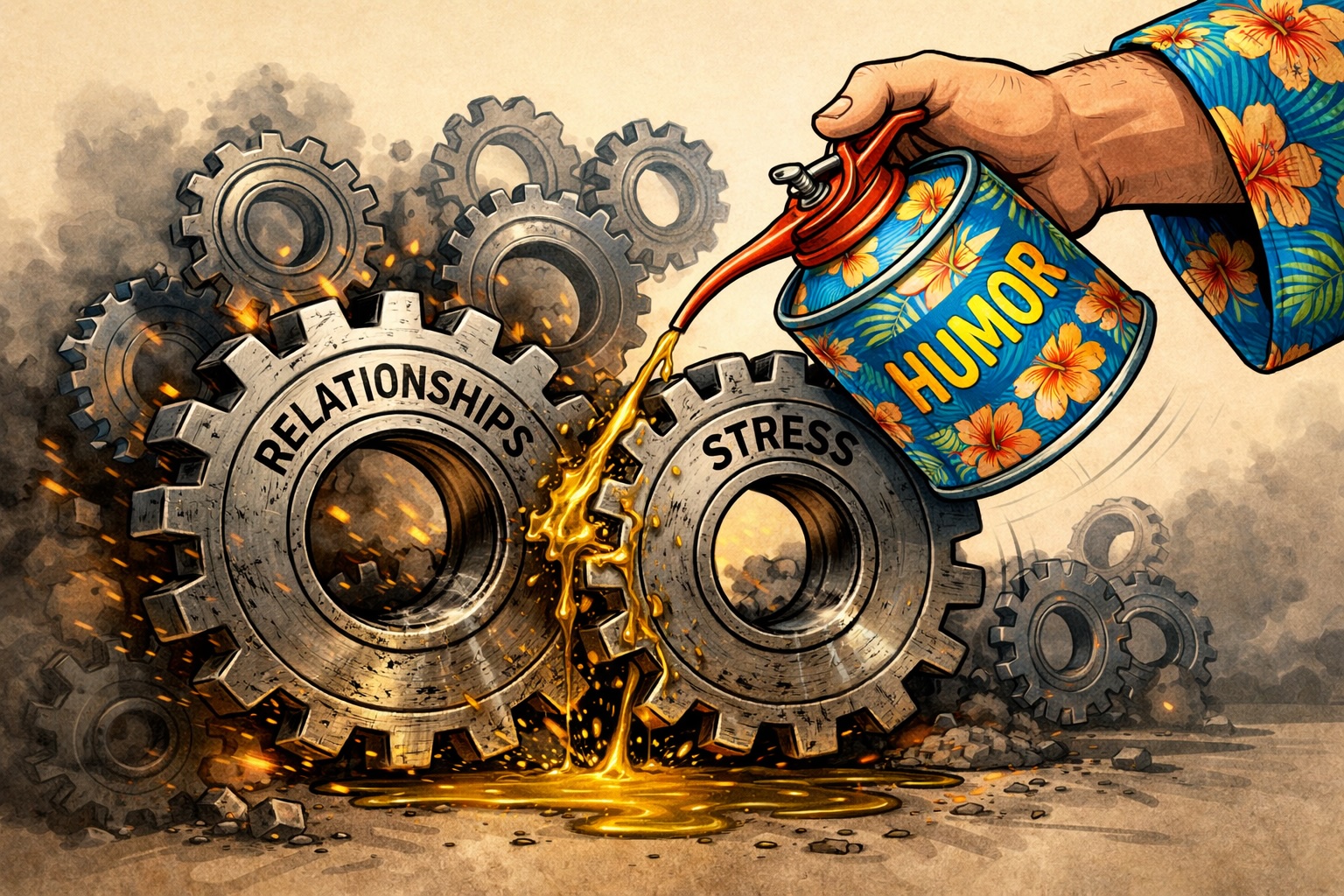
Laughter Is Like Lubricant

Social Lubricant

Let’s be honest: even in the best relationships, the gears are gonna grind.

Now add in “environmental factors”—as in, the world is more than a little nuts. No—make that super-duper stressful.

We’re not talking busy season.
We’re talking a world that is, by any objective standard, a little unhinged… maybe even spinning out of control.

And most of us are trying to stay reasonable, composed, and productive. Here’s how it looks:

We tighten up.
We get serious.
We handle things.

And then—slowly, quietly—that tension and seriousness start leaking into our relationships.

Wind the gears this tight?

They grind.
Sparks. Steam. Smoke.

Serious works for emergencies.
As a lifestyle, not so much.

Humor Changes the Space Between People

This isn’t just about couples.

This is about:

  • your kids
  • your friends
  • your parents
  • your coworkers
  • that nonprofit board meeting that could really use a pulse

Humor works everywhere.

Because in every relationship, the gears grind.
Misunderstandings happen. Tension builds. People get a little… prickly.

When that happens, you need something to get things moving again.

Laughter and play do that.

Humor doesn’t fix everything.
But it loosens things enough to get them moving—and sometimes that’s all you need to make space for repair.

It reminds everyone: we’re okay.

Here’s What I Don’t Mean

The second you try to be funny, you stop being funny.

Humor is not:

  • performing
  • delivering clever lines on demand
  • sarcasm disguised as personality

Especially that last one.

Sarcasm is wildly popular in struggling relationships—
and a big reason they keep struggling.

Yes, it’s witty to the person saying it.
Less so to the person on the receiving end.

If your wit comes at someone else’s expense?

That’s not wit.
That’s a hit.

Also—humor isn’t a way to dodge responsibility.

If you messed up, own it.

Then maybe laugh about it later.

How to Not Do It

The moment you think:

“OMG, I need to be funny right now!”

…it’s over.

That pressure shuts everything down.

It’s like dancing.

Relaxed? You’re fine.
Trying to be good? Malfunctioning robot.

No one is asking you to be a comedian.

We’re trying to:

  • connect
  • lighten the moment
  • take a little pressure off

That’s it.

It’s Not as Hard as You Think

You’re not creating humor—you’re catching it.

Life is already ridiculous. You just have to notice the joke.

Point at what’s already happening and say:

“Are we seeing the same thing right now?”

That shift—
from control → curiosity
from irritation → observation

—that’s where humor lives.

How to Find Your Humor Groove

(Yes, you can do this.)

No formula. No script.

  1. Notice the Absurd
    Everything is a little ridiculous if you look at it sideways.
  2. Say the Slightly Offbeat Thing
    Not a joke. Just your take.
    “So this is how today’s going.”
  3. Start With Yourself
    “I’m 90% sure I just made that worse.”
    Now everyone can breathe.
  4. Play the Moment
    Something goes wrong? That’s material.
  5. Keep It Small
    This isn’t a performance.
    It’s a moment.

It’s Not What You Say. It’s How You Say It

Delivery beats material. Every time.

You can say something hilarious in a flat, tense voice…
and it lands like a tax audit.

Meanwhile, a mildly funny comment delivered with a smile?

That works.

People signal humor.

They smile.
They soften their tone.
They let you know: this is safe.

If you’re new to this, skip deadpan.

That’s advanced class.

Using Humor When Things Are Tense

Humor can help.
It can also make things worse.

So:

  • soften, don’t win
  • keep it gentle
  • read the room

If it doesn’t land?

Let it go.

You don’t control humor.
You definitely don’t control how it’s received.

We All Have Humor

Sometimes it’s buried under:

  • stress
  • burnout
  • needing to be right
  • taking yourself very seriously

Those are real.

But ask yourself:

At the end of your life…
do you want to be known as the person who was always right?

Or the one people actually enjoyed being around?

Because those are not the same person.

And no—no one’s lying there wishing they’d been more serious.

The Shift That Changes Everything

Stop trying to make humor happen.

Start noticing what already is.

You don’t need better material.
You need a different lens.

And yes—that means letting go of control.

Which, let’s be honest…

isn’t working that well anyway.

Bonus: Try This Tonight

  • Say one ridiculous observation out loud
  • “We’re doing the thing again, aren’t we?”
  • Joke about yourself instead of defending
  • Turn a small problem into a running bit
  • Let one moment be funny instead of efficient

The Last Laugh

Communication, commitment, and trust don’t come from good intentions.

They come from what you actually do—day in and day out—with the people in your life.

If you create moments that say, “this is still good,”
your relationships are far more likely to be.

Humor helps create those moments.

Not by fixing everything.

Just by reminding us we’re in it together.

Why the Couple Is the Foundation of a Healthy Family System

The most important thing in your relationships is your partner.
More important than:

  • your ex(es).
  • your children.
  • your parents.

Put another way: In a healthy family system, the couple sits at the top of the family hierarchy.
Not above each other.
Above everyone else: kids, pets, and extended family.

This idea reliably makes people uncomfortable, so before anyone starts yelling equality!, let’s slow down.

Families are not democracies, and children (or Labradoodles) are not junior board members. Equal dignity does not mean equal authority.

Hierarchy gets a bad reputation because people confuse it with dominance, authoritarianism, or patriarchy. Let’s reframe the question from “Who’s in charge?” to “Who’s responsible?”

Your children will run the show…

…if you let them.

It doesn’t matter that they lack the brain development, emotional regulation, and life experience required to manage adult responsibility. When no one is clearly in charge, nature abhors a vacuum—and your children will slide right into the space where your better judgment should be.

This is not healthy. For them or for you.

A child who thinks, “I’m in charge!” does not sleep better at night. (For one thing, there’s no bedtime.) And I sincerely hope I don’t have to explain why it’s also not great for the adults.

Being “at the top” doesn’t mean being harsh, arbitrary, or controlling. It means being clear, fair, consistent, and predictable. You guide more than you dictate. You listen—without handing over the keys.

Yes, this applies to pets too

I love animals. I really do.

But prioritizing a pet’s comfort, routines, or preferences over your partner’s well-being is a reliable way to damage a relationship. This most often shows up not with well-adjusted, well-trained pets, but in situations where a pet’s needs are unmanaged or overwhelming—aging pets struggling with incontinence, chronic illness, or frequent vomiting; animals that were never properly trained; or pets whose presence triggers allergic or health reactions in a partner.

In those cases, the issue isn’t the pet—it’s the absence of limits, problem-solving, or shared responsibility. When one partner is expected to simply tolerate disrupted sleep, persistent messes, odors, health issues, or loss of shared space “because the pet comes first,” the message is clear, even if unintentional.

That message is not repairable through reassurance alone.

And in case you’re wondering why I bring this up: I’ve seen the damage “fur babies” can do to adult relationships more times than I care to count—not because the animals are bad, but because the couple isn’t treating their relationship as the primary one.

What about extended family?

Extended family is trickier. Culture, finances, and caregiving realities matter. But the principle still holds: too many people “in charge” creates confusion, divided loyalties, and stress. Children quickly learn to exploit gaps in an unaligned parenting team, and adults burn out trying to keep everyone happy.

A stable family needs a clear center.
And that center must be the couple.

OK, but what about cultures where caring for extended family is expected?

In many cultures, caring for aging parents or younger siblings is not optional—it’s a moral obligation. Multi-generational households are common, functional, and deeply meaningful. None of that contradicts the idea that the couple should be the center of the family system.

The issue is not whether extended family is included.
The issue is how decisions are made, and whose needs are treated as non-negotiable.

A couple can live with extended family and still be the primary unit—if decisions about caregiving, finances, privacy, and boundaries are made together. What becomes corrosive is when these arrangements are inherited by default, rather than chosen deliberately by both partners.

Cultural tradition does not require a spouse to disappear.
Nor does honoring parents require sidelining the marriage.

Problems arise when care obligations are treated as fixed and unquestionable, and the new spouse is expected to adapt silently. That’s not cultural respect—it’s unilateral decision-making dressed up as duty.

In healthy family systems—across cultures—extended family may be deeply honored, supported, and protected. But the marriage itself is not structurally subordinate to them.

Hierarchy isn’t about exclusion.
It’s about clarity.

And clarity is what allows care, commitment, and culture to coexist—without quietly breaking the couple in the process.

OK, but what if the kids are grown?

This is the follow-up question, and it matters.

What happens when people remarry after the kids are grown and out of the house? Who gets prioritized—the adult children or the new spouse?

Short answer: the spouse still gets priority.
Even then. Especially then.

That doesn’t mean abandoning your children. It means deciding who the organizing center of your adult life is.

Marrying into an established family is one of the hardest roles there is. The new spouse doesn’t just feel like an outsider—for all practical purposes, they are. The kids have history, routines, inside jokes, and a lifetime of access. The spouse is the newcomer trying to build trust and feel commitment in a system that existed long before they arrived.

Especially early in marriage, trust-building is one of the most important tasks. And here’s the part people miss: it doesn’t matter what someone says if their actions consistently communicate, “My primary allegiance is to my kids. Or my dog. Or my ex. Or my mom.” In those situations, the spouse will never feel on solid ground.

This is one reason many second marriages struggle early on—not because people don’t care, but because they try to juggle too many competing allegiances at once. Things get much clearer (and often much easier) when spouses intentionally prioritize each other over all others.

The takeaway

Hierarchy in families isn’t about favoritism.
It’s about clarity.

The spouse comes first.
Everyone is still loved.
Nobody is erased.

But when the couple is not clearly centered, families don’t become more equal.
They become more chaotic, less stable.

And chaos is a terrible way to run a household.

Interview on ADHD with Peter Shankman

Faster than Normal is the nation’s #1 ADHD podcast, hosted by Peter Shankman.

In this episode Peter & Luis discuss:

0:40-  Intro & welcome Luis!

1:50-  Sometimes ADHD is not at the actual root of a kid’s trouble.

2:30- How & why did you switch from running your own agency to helping and treating kids?

3:08-  So, with what types of kids are you usually working?

4:34-  Talk to us about the stigma attached to mental health from your experiences

6:16-  Why do you think it’s taking so long to break down the stigmas?

6:40-  On mental health within the stoic culture of many immigrant parents

8:53-  Kids on the spectrum usually have a pretty tough time opening up; what do you do to break through to them?  Ref:  Jennifer Hartstein interview  

12:28-  How are you framing ADHD to kids? How do you fight the “you are broken” residuals?

13:05-  On parenting an ADHD child

15:23-  Often, when parents hear a diagnosis, they go deaf to anything said afterwards. How do you handle that?

18:41-  Luis, how can people find you on the socials? LinkedIn @ Luis Maimoni

19:00-  Thank you Luis! And thank YOU for subscribing, reviewing and listening. Your reviews have been working! Even if you’ve reviewed us before, would you please continue to do so. Each review you post helps to ensure that word will continue to spread, and that we will all be able to reach & help even more people! You can always reach me via peter@shankman.com or @petershankman on all of the socials. You can also find us at @FasterThanNormal on all of the socials.

19:20-  Faster Than Normal Podcast info & credits

Parenting in the Pandemic

COVID-19 has brought plenty of stress to all of us: masks, social distancing, closures, and shelter-in-place recommendations. Now, the school year is almost upon us, the pandemic is raging, and politicians, pundits, pediatricians, and public health officials are arguing about whether children should go back to (physical) school. No sense making it easy on the parents, right?

Your child is probably even more stressed than you are. Why? Imagine feeling all the stress you’re feeling, but with less control over the outcomes. If your child is “acting out,” it might not be intentional misbehavior – it might be feelings of stress or anxiety being expressed through misbehavior. Sure, you can ask about your child’s feelings, but most likely, you’ll hear an answer designed to please you rather than inform you. Therefore, understanding misbehavior can be the best way of learning what your child is actually feeling.

Signs of Anxiety in Your Child

We grownups often have a tough time expressing our feelings (remember the first time you said, “I love you”?) For children, it’s even tougher. Your child’s mind is still under development. Emotional expression and self-regulation are still coming online for K-6 age children, and expressing feelings with nuance and insight comes later still. As a result, most children communicate their feelings through behaviors.

What behaviors might indicate anxiety? Is she asking more questions than usual? Is he talking back more? Is she bored? Are they fighting more? Is he regressing? Is she withdrawn? Irritable? Edgy? Clingy? Refusing to talk about going back to school? Any of these behaviors could be signs of anxiety (and/or other emotions).

Worried Feelings Make Worried Behaviors

If you’re seeing these sorts of behaviors in your child, it could mean that he or she is worried about going back to school. To understand how to respond, it is necessary to make a fine distinction: it’s not going back to school making your child act out. It’s her thoughts about going back to school that are making her anxious, which in turn is making her act out. The behaviors/symptoms you’re seeing are her emotional system’s attempts to get back to a secure emotional place. To address the misbehaviors, you must address the root cause: an unmet need for safety and security, which is driving anxious thoughts.

What You Can Do

Anxiety is thinking (worrying) about the unknown. If you can teach your child “how to make the unknown, known,” your child will learn to manage his own anxiety.

When we’re anxious, we look for where the danger is, and where the safety is. Answering those questions helps us get control of ourselves. This skill, which you have learned instinctively, is a skill you can teach your child to help manage his anxiety. To start, think carefully about what you’re seeing your child doing and figure out if he is looking at danger, or is he looking for safety.

If he is asking questions, talking back, edgy, irritable, or fighting, he is probably focused on the threat. If he’s withdrawn, regressing, or clingy, he’s probably seeking safety.

Gain an Understanding

As mentioned above, addressing the behavior requires understanding the unmet need driving negative thoughts. If your child is responding to fear, ask questions that help you identify what your child seems to be afraid of. The first answers you get may require some follow ups to get to the root of the issue. For example, if your child says she is worried about going back to school, follow-up to get a more specific answer. What is the actual threat? Talk out the unknowns. She might say she doesn’t want to wear a mask all day. She might be worried that her friends won’t like her anymore.

Once you understand the thought behind the fear, you can focus on it. Alternatively, if your child is seeking safety, focus on steps he can take to stay safe. Make a plan. What can he do? Make sure he has the “resources” he needs to feel safe. Either way, remember that your conversation needs to be short and focused. If it goes long, and you find yourself making promises you’re not sure you can keep, you may be addressing your own needs instead of your child’s.

If All Else Fails

If your child is still acting out, or if you find that you’re having problems managing your own anxiety, it may be time to seek professional help. Happy parenting!

Sidebar