Marriage and Family Therapist in Long Beach, California

Category: Men’s issues

What does it mean to be a man these days?

Gaslighting? Maybe Not.

The Week That Stayed With Me

I had a rough week in the office. I love this work, but a few couples left me thinking they needed individual therapy before they could do anything together. That doesn’t happen often. Most couples can stay in the room long enough to slow down, hear each other, and take responsibility for their part of the mess. It isn’t always pleasant, but it’s possible.

This week, it wasn’t.

I’m changing the details, but the tone is the same. Husbands who felt misunderstood. Wives who felt unheard. Men who felt blamed. Women who felt dismissed. Everyone injured. The low point was watching tearful women get interrupted by men who did the same to me when I stepped in. By the end, the women were upset and exhausted while the men were still explaining why their reactions made sense.

These sessions don’t pass through me easily. They stayed with me long after the door closed. My mind kept circling the word that shows up everywhere online: gaslighting.

The Trouble With the Word “Gaslighting”

The internet has turned gaslighting into a catch‑all. Invalidation? Gaslighting. Defensiveness? Gaslighting. Disagreement? Gaslighting. And yes, some of the phrases I heard this week show up in every list:

  • “You’re being dramatic.”
  • “You’re blowing things out of proportion.”
  • “I’m sorry you feel that way.”

Gaslighting is real. It’s serious. It’s what happens when someone tries to erode another person’s confidence in their own perception or memory. Sometimes it’s intentional. Sometimes it isn’t. Either way, the result is the same: the targeted partner begins to doubt themselves.

But as I sat with these sessions, I found myself wondering whether the word was helping me understand what I was seeing.

What I Actually Saw in the Room

The men in front of me didn’t look calculating or cruel. They looked overwhelmed. One experienced any request as criticism. Another felt attacked whenever his wife disagreed. One couldn’t understand why his infidelity was still a problem after the affair ended. Another insisted his belligerence was a reasonable response to his wife’s escalation. They weren’t manipulating reality. They were defending themselves from feelings they didn’t know how to manage.

The problem lived somewhere else — in the relationship, in the expectations, in the history between them. And since these men didn’t believe they were part of the problem, they weren’t curious about their contribution. I’ve seen plenty of online rants describing men like these as controlling or power seeking. Sometimes that’s accurate. This week, it wasn’t. What I saw were men who felt inadequate and blamed, trying to solve a problem they didn’t know how to solve. “Please help me” was getting translated into “You are not enough.”

Understanding that doesn’t excuse the behavior. It does explain why calling someone a gaslighter rarely helps. It becomes one more accusation. One more jab. And the result is predictable: more defensiveness, more escalation, more volume, more interruptions.

Intimidation Without Intent

There’s another piece I don’t see discussed much, and it’s particular to heterosexual relationships: intimidation.

Our nervous systems notice things we don’t always name. Volume. Anger. Interruptions. Emotional intensity. Physical presence. A person becoming larger in the room. Whether or not intimidation is intended almost doesn’t matter. The nervous system responds to what it perceives, not what was meant.

When someone talks at length, with increasing volume, and stops listening, it can be intimidating — especially for people who were raised to keep the peace.

And that’s where the gut punch landed for me this week: watching the women disappear.

When the Nervous System Chooses Safety

Most people know fight, flight, and freeze. Fawn gets less attention. Fawning is what happens when the nervous system decides that accommodation is safer than confrontation. A person softens. They appease. They shrink. From the outside, it can look like agreement. It can even look like progress.

These women began by advocating for themselves. They explained their concerns, challenged what they were hearing, and tried to be understood. Their partners defended themselves, explained their logic, and argued that their reactions made sense. The temperature rose. The men became more activated. Their explanations grew longer and more emphatic.

And then something shifted.

One woman cried. Another went quiet. One softened her language. Another stopped challenging altogether. They disappeared right in front of me.

The men experienced the conversation as finished because the conflict had stopped. The women experienced it as impossible because continuing no longer felt safe or worthwhile. The room shrank. The range of acceptable thoughts narrowed. The person most comfortable with conflict took up all the emotional space. Neither of them was lying. They were living in two different worlds.

And the problem itself stayed exactly where it was.

Why the Work Had to Shift

Couples therapy assumes both people can tolerate influence. It assumes both can stay present, examine themselves, and ask hard questions about their own behavior. When one partner can’t yet ask, “What is my contribution here?” the work sometimes needs to become individual before it can become relational.

That’s why I recommended individual therapy.

For what it’s worth, being referred to individual therapy doesn’t mean anyone is a villain or that the relationship is doomed. It means the changes the relationship needs are more likely to come from individual work than from couples work. Therapy is therapy, but couples therapy is different than individual therapy. And the work in front of each partner was different, which often makes individual therapy the better place for those needs to be met.

You won’t be surprised that the men declined the referrals and the women accepted them. People seek help for problems they believe they have, not for problems someone else believes they have.

Even so, these relationships can get better. Life is larger than the moments that unfold in a therapy office. Better self‑understanding, better communication skills, and a clearer sense of relational patterns can change a relationship.

What Couples Therapy Can and Can’t Do

My pride requires me to add that couples therapists help many couples. People do change, relationships can heal, and even difficult ones can be treated well through couples work. But couples therapy is often about communication, and communication skills need a foundation that isn’t always there. Put another way, sometimes the first step isn’t learning to communicate better. Sometimes it’s understanding why one person has stopped speaking and why the other can’t hear anything except criticism. Until those questions are answered, communication techniques don’t have much to stand on.

In this relationship. Or the next.

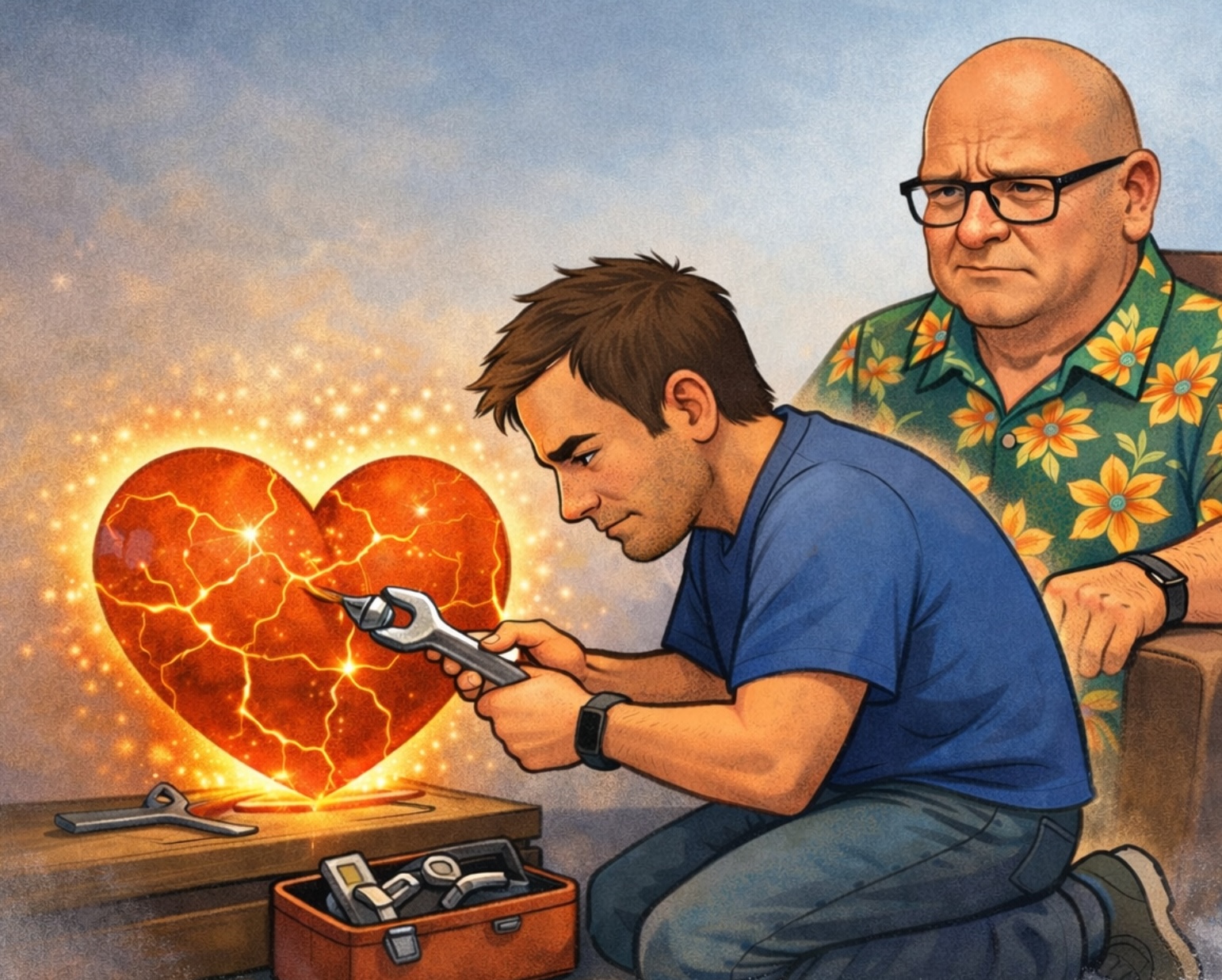
Feelings Are Feminine

The right tool for the right job.

Yes, there it is: I said it.

But I’m not the first to say it. This is a message that gets repeated for men and boys countless times, and countless ways.
“Ignore the pain.”
“Get a job.”
“Get over it.”
“Man up.”

And much worse.

I’ll tread carefully here. This is a gendered topic, and those can get overheated fast.

You could argue it’s better to avoid it. But when you see the same pattern week after week in your office, avoidance stops being helpful.

At some point, it needs to be named.

A man comes in because his relationship is struggling. He cares about his partner. He wants things to be better. He’s trying. And still, his partner has a list of complaints:

“I don’t feel connected to you.”
“You’re too angry.”
“You don’t open up.”
“I don’t feel like you really see me.”

His thoughts are confused. From his perspective, he’s showing up. He’s thinking about the relationship. He’s trying to solve the problems. He’s loyal. He’s present.

What’s worse is what he’s feeling: helplessness. Worse than that: he can’t identify the feeling other than discomfort leading to irritation leading to defensiveness. The path from defensiveness to anger is short.

It makes no sense to him why all the work he’s doing isn’t translating into connection—and, at times, still leaves him feeling unseen or unappreciated.

Thinking Instead of Feeling

Men learn early that feelings are feminine. If they let themselves experience—or worse, express—feelings, they risk being seen as weak.

So they adapt.

They analyze.
They problem-solve.
They try to “fix” things.

Valuable skills. Helpful, certainly.

But connection—the kind that sustains intimacy—is not primarily a thinking process. It’s an emotional one.

If you can’t access your own emotional experience, it becomes very difficult to attune to someone else’s.

That’s not a character flaw. That’s a skill gap.

How We Got Here

The Gottman Institute recently wrote about how boys are often taught, directly and indirectly, to move away from their emotional experience.

This isn’t just cultural commentary. There is research behind it.

A large body of developmental research shows that gender differences in emotional expression are not present at birth, but emerge over time through socialization—what boys and girls are taught is acceptable to feel and show.

By early childhood, boys are already being steered toward externalizing emotions like anger, while girls are more supported in expressing sadness, empathy, and vulnerability.

And those patterns matter, because emotional expression is not just “nice to have”—it’s tied directly to social competence and relationship functioning.

There’s Even a Name for It

When someone has difficulty identifying and expressing their emotions, we call that alexithymia.

Plain English: “I feel something… but I have no idea what it is.”

That doesn’t mean the feelings aren’t there.
It means they were never learned, named, or practiced.

And if you can’t identify what you feel, you can’t share it.
And if you can’t share it, your partner can’t feel connected to you.

This Is Gonna Hurt

When emotional awareness is limited, relationships feel it.

If you can’t clearly identify what you’re feeling:

  • It’s harder to communicate it
  • It’s harder to stay present with someone else’s emotions
  • It’s easier to default to thinking instead of feeling

Your partner experiences that as distance. Yes, you care, but they can’t feel it.

When thinking replaces feeling, conversations start to look like this:

  • logical instead of emotional
  • solutions instead of connection
  • explanations and defensiveness instead of shared experience

Now you have all the ingredients for escalation—and all the offramps are still “under construction”.

Why Anger Becomes the Go-To

Short version: for many men, the first response to relational stress isn’t anger—it’s avoidance. Work, screens, distraction, staying busy—anything that keeps them from having to sit with what they’re feeling.

That can work for a while.

But when avoidance stops working—when the pressure builds or the relationship pushes for connection—something has to come out. And often, what comes out is anger. For some men, it’s the safest emotion available. For others, it’s the only one they know how to access.

Yes, that sounds backwards.

But vulnerability—fear, hurt, shame—has often been met with ridicule or rejection. Anger, on the other hand, is familiar, accessible, and even socially permitted. So it becomes the default.

Underneath anger, there’s usually:

  • hurt
  • fear
  • shame
  • disappointment

When those emotions aren’t accessible, anger ends up carrying the load—and that creates problems in relationships.

Emotionally Blind—and In a Bind

This is the part we don’t talk about enough.

Many men were never taught how to be emotionally aware or expressive, and then, as adults, they’re expected to be emotionally attuned partners. That’s a tough transition—even if there were a clear roadmap. And there isn’t one.

So men do what they’ve been trained to do: they try to solve an emotional problem using the tools they have. They think harder, analyze more, and try to figure it out.

But emotional connection isn’t something you can think your way into. It’s something you have to feel your way into.

And if you were never taught how to do that, it’s frustrating—for the men I see in my office, and frankly, for me too.

Speaking of the Therapy Office

If a man is struggling with emotional connection, intimacy, or communication, the question often comes up: is this individual work, or couples work?

The answer is: it depends.

If anger is severe—or if safety is a concern—individual work needs to come first. But for many couples, the issue isn’t danger. It’s disconnection. And connection is a relational skill, which means it often develops best in a relational setting.

Couples therapy gives people a chance to practice things that are hard to learn alone: staying present with emotion, expressing vulnerability, and responding to a partner in real time. Those are not abstract skills. They are lived, relational experiences.

Regardless of where the work happens, the core is the same: staying in the conversation when it feels uncomfortable, saying the thing that feels awkward, and allowing emotion to be present without immediately trying to fix it.

That’s the work.

If You’re a Man Reading This

If any of this resonates, there’s nothing “wrong” with you. You learned what you were taught. But those lessons may not serve you in the kind of relationship you actually want.

The good news is that these are skills, and skills can be learned. Emotional awareness is learnable. Connection is learnable. Intimacy is learnable.

You don’t have to become a different man. You become a more capable one.

If You’re Seeing Your Man in This

This may help explain what you’re experiencing. It doesn’t excuse harmful behavior, but it can help make sense of the gap.

What looks like disinterest is often limited access. And that can change—but only if he’s willing to do the work.

Until then, your role may need to be different: clarity about what you need, boundaries around what you will and won’t accept, and a willingness not to over-function on his behalf.

You can’t do his work for him.

The Bottom Line

We ask men today to be:

  • strong
  • capable
  • reliable
  • and emotionally present

That last one requires a skill set many men were never taught.

But it can be learned.

And when it is—it changes everything.

Money fight? Math’s Not the Problem

The Stereotype Showdown

You’ve probably heard it—or maybe even said it:
“She just loves to splurge.”
Or maybe:
“He’s such a tightwad.”

But what if arguments about money aren’t really about money at all—but about power, priorities, and feeling seen?

A friend recently suggested that women overspend while men think more economically. It’s a common belief—but is it true? And even more importantly: is that really the problem?

What the Data Says

Spoiler: it’s not about handbags vs. hardware.

Yes, men and women spend differently. But here’s what that actually means:

  • Women tend to spend more on household goods, children, groceries, and caregiving—often because they do more of the caregiving.
  • Men tend to spend more on big-ticket items like electronics, sporting events, and automobiles. Spoiler alert: a kayak, a new phone, and playoff tickets will run you a bit more than some candles and concealer.

Now here’s where it gets good:

  • Men are more likely to stay within a budget.
  • Women are more likely to set the budget in the first place.

So the guy sticking to the budget? Often working off her spreadsheet.

And yes, women go over budget more frequently—but often because they’re shouldering more of the single-parenting, elder care, and daily survival costs. Their spending isn’t about impulse. It’s about responsibility.

In short: it’s complicated. (Click here for the long version.)

Arguments about money are rarely about who bought what, for how much. They’re about who gets to decide what matters.

Two Options

Before you judge your partner’s purchases, understand what they’re actually buying.

  • A new outfit might be about self-worth.
  • That new game console might be about freedom, escapism—or maybe even avoidance.
  • The fifth kitchen gadget? Could be about trying to get it all done when there aren’t enough hours in the day.
  • The fancy candle? Maybe it’s about peace in a house full of chaos.

The spend is never the full story.

If you’re worried about how your partner spends, here are two options:

Set up a budget with separate “fun money”

Create a shared household fund for essentials, and individual monthly “no-questions-asked” spending accounts.
If he wants a fur-lined bathtub, that’s his call.
If she wants an electric dog tooth polisher, that’s hers.
(Yes, those are real things. We Googled.)

Celebrate the diversity of your choices—and make sure the dog’s teeth aren’t polishing the bathtub.

Be curious. Not critical.

Don’t ask, “Why did you buy that?” Instead, be curious. Explore:

  • “What’s important to you about this?”
  • “What were you hoping to feel?”

Your partner isn’t the enemy, and you’re not a prosecutorial version of Judge Judy with a joint checking account.

Your partner’s spending reflects who they are—and guess what? You picked ’em. So put down the gavel and use the moment to learn a little bit more about your partner..

Once you’re able to appreciate them for who they are, it’ll also make it a lot easier for them to understand why you spent $12,000 on that hallway portrait that “just spoke to you.”

Bottom line:
If the fight about spending is actually a fight about feeling seen, no spreadsheet is going to save you.

When Respect Feels Missing: A Conversation About Gender, Connection, and Emotional Needs

Thinking About Gender

I was talking with a friend the other day, and he was wondering out loud: Why do women so often say men don’t understand them? It struck me as a fair question. I get a lot of business due to couples having problems communicating with – understanding – each other. No matter how we define or construe gender, there always seem to be misunderstandings.

In popular culture—and often in my therapy office—men are frequently framed as emotionally out of touch. Unwilling, or maybe unable, to engage with nuance. It’s a stereotype, sure, but one that resonates with many people’s lived experiences.

As the conversation continued, my friend shifted gears. He talked about how society seems to be cheering for women in ways that feel visible and celebrated—more women in college, more women starting businesses, more women in leadership. And he’s right: there’s real movement happening.

But alongside that progress, he said, men’s struggles often feel minimized or ignored. That left him—and maybe others—feeling unsure of their place. Like they’re showing up, doing the work, but no one’s really noticing.

Then he said something that gave me pause: “Women don’t seem to understand that men want respect and admiration.”In contrast, he felt women often want to feel emotionally understood.

That idea—respect vs. understanding—may not be universal, but it is familiar. And while research suggests there are some gendered trends in emotional needs, the bigger truth is this: we’re all shaped by more than our gender. Culture, upbringing, life experience—all of it influences how we show up in relationships.

Still, I don’t think my friend was trying to win an argument. I think he was trying to name something he hadn’t quite said out loud before.

In a culture that increasingly centers women’s voices and progress, some men feel unseen, unneeded, or emotionally irrelevant. Women, in seeking emotional understanding, may overlook that men often experience love not through emotional decoding but through expressions of respect, trust, and admiration. The communication gap isn’t just between two people—it’s between two social narratives.

And when those narratives collide—when one partner is seeking emotional resonance and the other is longing to feel respected—we get tension, disconnection, and the all-too-familiar “You don’t get me” loop.

But here’s the good news: understanding and respect aren’t mutually exclusive. They’re just different doors to the same room. Relationships thrive when we stop assuming the other person should love like we do, and instead get curious about what love looks like to them.

So I turned to my friend after we’d had this conversation and told him I respect where he’s coming from. I said I hoped he was feeling seen and heard in his relationship—and then I asked if he felt respected. If he felt like the people in his life really got him.

Sure enough, he said no. He felt misunderstood. Maybe underappreciated for all the work he does. I validated that—because it’s real.

And then I asked the payoff question: “What would you like to do about it?”

As he started to talk about the changes he might make, I thought to myself, Be careful what you wish for. And then I wished him well.

If we can stay curious about each other, we’ve got a shot at getting it right.

Sidebar