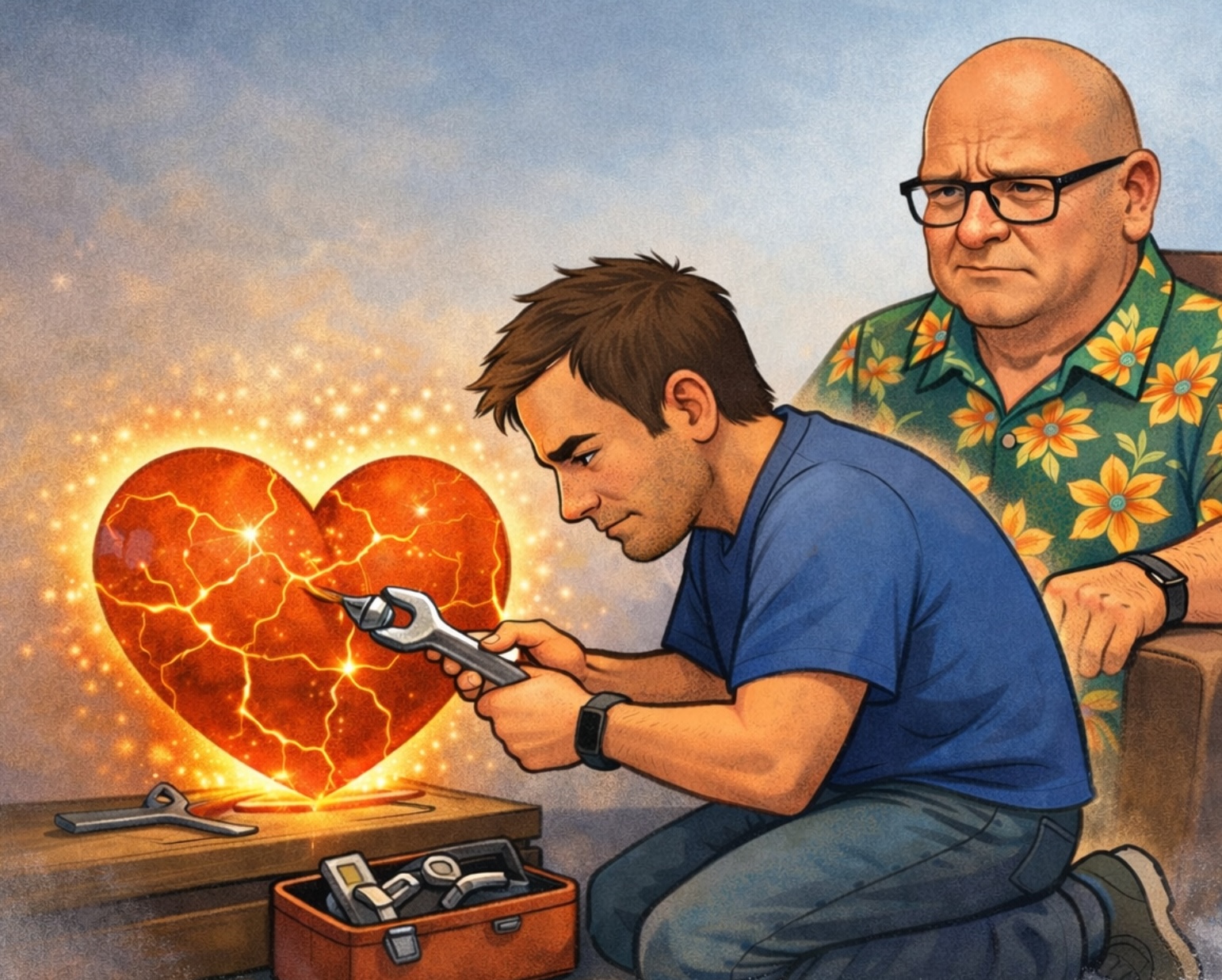
The right tool for the right job.
Yes, there it is: I said it.
But I’m not the first to say it. This is a message that gets repeated for men and boys countless times, and countless ways.
“Ignore the pain.”
“Get a job.”
“Get over it.”
“Man up.”
And much worse.
I’ll tread carefully here. This is a gendered topic, and those can get overheated fast.
You could argue it’s better to avoid it. But when you see the same pattern week after week in your office, avoidance stops being helpful.
At some point, it needs to be named.
A man comes in because his relationship is struggling. He cares about his partner. He wants things to be better. He’s trying. And still, his partner has a list of complaints:
“I don’t feel connected to you.”
“You’re too angry.”
“You don’t open up.”
“I don’t feel like you really see me.”
His thoughts are confused. From his perspective, he’s showing up. He’s thinking about the relationship. He’s trying to solve the problems. He’s loyal. He’s present.
What’s worse is what he’s feeling: helplessness. Worse than that: he can’t identify the feeling other than discomfort leading to irritation leading to defensiveness. The path from defensiveness to anger is short.
It makes no sense to him why all the work he’s doing isn’t translating into connection—and, at times, still leaves him feeling unseen or unappreciated.
Thinking Instead of Feeling
Men learn early that feelings are feminine. If they let themselves experience—or worse, express—feelings, they risk being seen as weak.
So they adapt.
They analyze.
They problem-solve.
They try to “fix” things.
Valuable skills. Helpful, certainly.
But connection—the kind that sustains intimacy—is not primarily a thinking process. It’s an emotional one.
If you can’t access your own emotional experience, it becomes very difficult to attune to someone else’s.
That’s not a character flaw. That’s a skill gap.
How We Got Here
The Gottman Institute recently wrote about how boys are often taught, directly and indirectly, to move away from their emotional experience.
This isn’t just cultural commentary. There is research behind it.
A large body of developmental research shows that gender differences in emotional expression are not present at birth, but emerge over time through socialization—what boys and girls are taught is acceptable to feel and show.
By early childhood, boys are already being steered toward externalizing emotions like anger, while girls are more supported in expressing sadness, empathy, and vulnerability.
And those patterns matter, because emotional expression is not just “nice to have”—it’s tied directly to social competence and relationship functioning.
There’s Even a Name for It
When someone has difficulty identifying and expressing their emotions, we call that alexithymia.
Plain English: “I feel something… but I have no idea what it is.”
That doesn’t mean the feelings aren’t there.
It means they were never learned, named, or practiced.
And if you can’t identify what you feel, you can’t share it.
And if you can’t share it, your partner can’t feel connected to you.
This Is Gonna Hurt
When emotional awareness is limited, relationships feel it.
If you can’t clearly identify what you’re feeling:
- It’s harder to communicate it
- It’s harder to stay present with someone else’s emotions
- It’s easier to default to thinking instead of feeling
Your partner experiences that as distance. Yes, you care, but they can’t feel it.
When thinking replaces feeling, conversations start to look like this:
- logical instead of emotional
- solutions instead of connection
- explanations and defensiveness instead of shared experience
Now you have all the ingredients for escalation—and all the offramps are still “under construction”.
Why Anger Becomes the Go-To
Short version: for many men, the first response to relational stress isn’t anger—it’s avoidance. Work, screens, distraction, staying busy—anything that keeps them from having to sit with what they’re feeling.
That can work for a while.
But when avoidance stops working—when the pressure builds or the relationship pushes for connection—something has to come out. And often, what comes out is anger. For some men, it’s the safest emotion available. For others, it’s the only one they know how to access.
Yes, that sounds backwards.
But vulnerability—fear, hurt, shame—has often been met with ridicule or rejection. Anger, on the other hand, is familiar, accessible, and even socially permitted. So it becomes the default.
Underneath anger, there’s usually:
- hurt
- fear
- shame
- disappointment
When those emotions aren’t accessible, anger ends up carrying the load—and that creates problems in relationships.
Emotionally Blind—and In a Bind
This is the part we don’t talk about enough.
Many men were never taught how to be emotionally aware or expressive, and then, as adults, they’re expected to be emotionally attuned partners. That’s a tough transition—even if there were a clear roadmap. And there isn’t one.
So men do what they’ve been trained to do: they try to solve an emotional problem using the tools they have. They think harder, analyze more, and try to figure it out.
But emotional connection isn’t something you can think your way into. It’s something you have to feel your way into.
And if you were never taught how to do that, it’s frustrating—for the men I see in my office, and frankly, for me too.
Speaking of the Therapy Office
If a man is struggling with emotional connection, intimacy, or communication, the question often comes up: is this individual work, or couples work?
The answer is: it depends.
If anger is severe—or if safety is a concern—individual work needs to come first. But for many couples, the issue isn’t danger. It’s disconnection. And connection is a relational skill, which means it often develops best in a relational setting.
Couples therapy gives people a chance to practice things that are hard to learn alone: staying present with emotion, expressing vulnerability, and responding to a partner in real time. Those are not abstract skills. They are lived, relational experiences.
Regardless of where the work happens, the core is the same: staying in the conversation when it feels uncomfortable, saying the thing that feels awkward, and allowing emotion to be present without immediately trying to fix it.
That’s the work.
If You’re a Man Reading This
If any of this resonates, there’s nothing “wrong” with you. You learned what you were taught. But those lessons may not serve you in the kind of relationship you actually want.
The good news is that these are skills, and skills can be learned. Emotional awareness is learnable. Connection is learnable. Intimacy is learnable.
You don’t have to become a different man. You become a more capable one.
If You’re Seeing Your Man in This
This may help explain what you’re experiencing. It doesn’t excuse harmful behavior, but it can help make sense of the gap.
What looks like disinterest is often limited access. And that can change—but only if he’s willing to do the work.
Until then, your role may need to be different: clarity about what you need, boundaries around what you will and won’t accept, and a willingness not to over-function on his behalf.
You can’t do his work for him.
The Bottom Line
We ask men today to be:
- strong
- capable
- reliable
- and emotionally present
That last one requires a skill set many men were never taught.
But it can be learned.
And when it is—it changes everything.