The most important thing in your relationships is your partner.
More important than:
- your ex(es).
- your children.
- your parents.
Put another way: In a healthy family system, the couple sits at the top of the family hierarchy.
Not above each other.
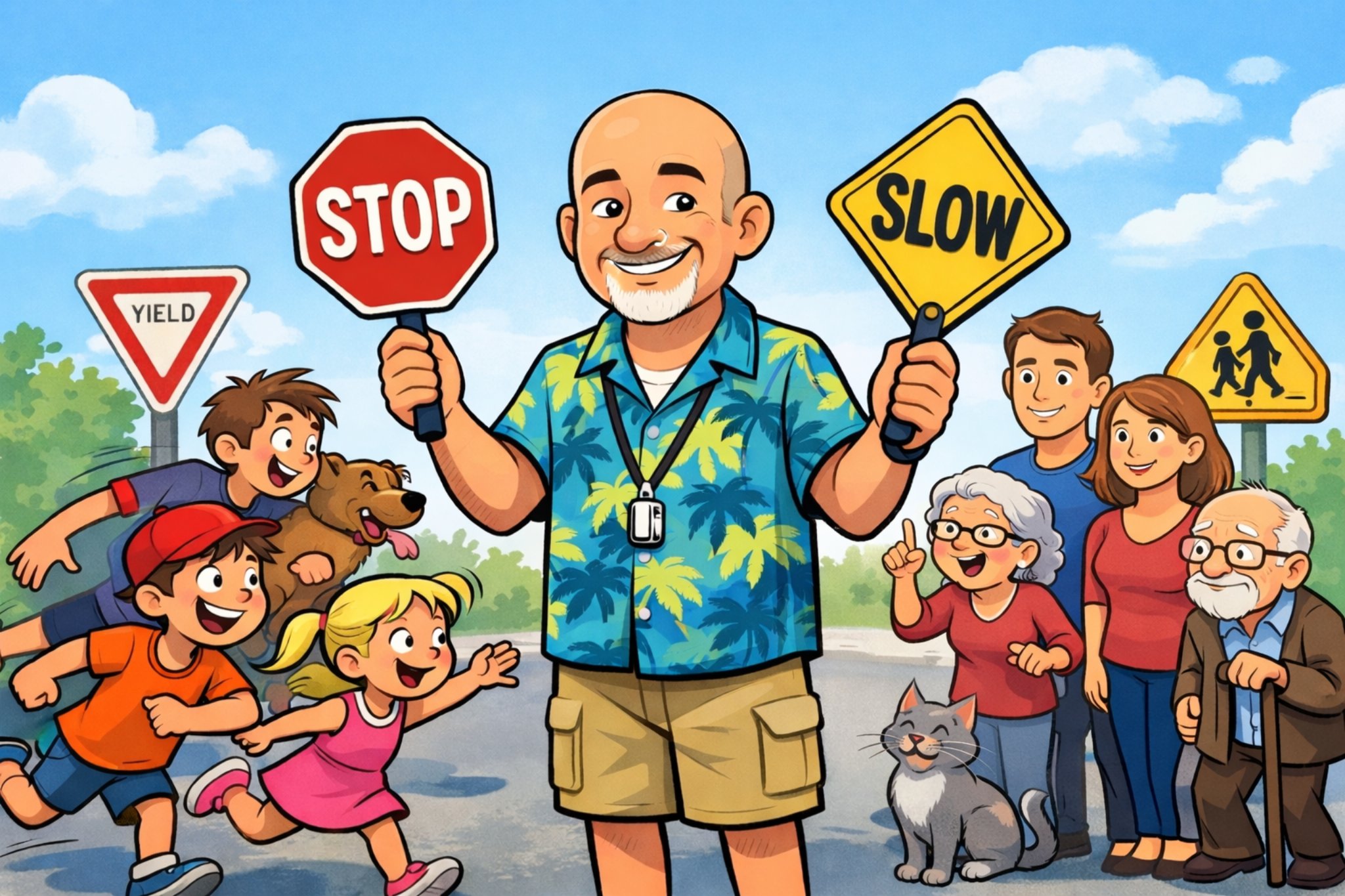
Above everyone else: kids, pets, and extended family.
This idea reliably makes people uncomfortable, so before anyone starts yelling equality!, let’s slow down.
Families are not democracies, and children (or Labradoodles) are not junior board members. Equal dignity does not mean equal authority.
Hierarchy gets a bad reputation because people confuse it with dominance, authoritarianism, or patriarchy. Let’s reframe the question from “Who’s in charge?” to “Who’s responsible?”
Your children will run the show…
…if you let them.
It doesn’t matter that they lack the brain development, emotional regulation, and life experience required to manage adult responsibility. When no one is clearly in charge, nature abhors a vacuum—and your children will slide right into the space where your better judgment should be.
This is not healthy. For them or for you.
A child who thinks, “I’m in charge!” does not sleep better at night. (For one thing, there’s no bedtime.) And I sincerely hope I don’t have to explain why it’s also not great for the adults.
Being “at the top” doesn’t mean being harsh, arbitrary, or controlling. It means being clear, fair, consistent, and predictable. You guide more than you dictate. You listen—without handing over the keys.
Yes, this applies to pets too
I love animals. I really do.
But prioritizing a pet’s comfort, routines, or preferences over your partner’s well-being is a reliable way to damage a relationship. This most often shows up not with well-adjusted, well-trained pets, but in situations where a pet’s needs are unmanaged or overwhelming—aging pets struggling with incontinence, chronic illness, or frequent vomiting; animals that were never properly trained; or pets whose presence triggers allergic or health reactions in a partner.
In those cases, the issue isn’t the pet—it’s the absence of limits, problem-solving, or shared responsibility. When one partner is expected to simply tolerate disrupted sleep, persistent messes, odors, health issues, or loss of shared space “because the pet comes first,” the message is clear, even if unintentional.
That message is not repairable through reassurance alone.
And in case you’re wondering why I bring this up: I’ve seen the damage “fur babies” can do to adult relationships more times than I care to count—not because the animals are bad, but because the couple isn’t treating their relationship as the primary one.
What about extended family?
Extended family is trickier. Culture, finances, and caregiving realities matter. But the principle still holds: too many people “in charge” creates confusion, divided loyalties, and stress. Children quickly learn to exploit gaps in an unaligned parenting team, and adults burn out trying to keep everyone happy.
A stable family needs a clear center.
And that center must be the couple.
OK, but what about cultures where caring for extended family is expected?
In many cultures, caring for aging parents or younger siblings is not optional—it’s a moral obligation. Multi-generational households are common, functional, and deeply meaningful. None of that contradicts the idea that the couple should be the center of the family system.
The issue is not whether extended family is included.
The issue is how decisions are made, and whose needs are treated as non-negotiable.
A couple can live with extended family and still be the primary unit—if decisions about caregiving, finances, privacy, and boundaries are made together. What becomes corrosive is when these arrangements are inherited by default, rather than chosen deliberately by both partners.
Cultural tradition does not require a spouse to disappear.
Nor does honoring parents require sidelining the marriage.
Problems arise when care obligations are treated as fixed and unquestionable, and the new spouse is expected to adapt silently. That’s not cultural respect—it’s unilateral decision-making dressed up as duty.
In healthy family systems—across cultures—extended family may be deeply honored, supported, and protected. But the marriage itself is not structurally subordinate to them.
Hierarchy isn’t about exclusion.
It’s about clarity.
And clarity is what allows care, commitment, and culture to coexist—without quietly breaking the couple in the process.
OK, but what if the kids are grown?
This is the follow-up question, and it matters.
What happens when people remarry after the kids are grown and out of the house? Who gets prioritized—the adult children or the new spouse?
Short answer: the spouse still gets priority.
Even then. Especially then.
That doesn’t mean abandoning your children. It means deciding who the organizing center of your adult life is.
Marrying into an established family is one of the hardest roles there is. The new spouse doesn’t just feel like an outsider—for all practical purposes, they are. The kids have history, routines, inside jokes, and a lifetime of access. The spouse is the newcomer trying to build trust and feel commitment in a system that existed long before they arrived.
Especially early in marriage, trust-building is one of the most important tasks. And here’s the part people miss: it doesn’t matter what someone says if their actions consistently communicate, “My primary allegiance is to my kids. Or my dog. Or my ex. Or my mom.” In those situations, the spouse will never feel on solid ground.
This is one reason many second marriages struggle early on—not because people don’t care, but because they try to juggle too many competing allegiances at once. Things get much clearer (and often much easier) when spouses intentionally prioritize each other over all others.
The takeaway
Hierarchy in families isn’t about favoritism.
It’s about clarity.
The spouse comes first.
Everyone is still loved.
Nobody is erased.
But when the couple is not clearly centered, families don’t become more equal.
They become more chaotic, less stable.
And chaos is a terrible way to run a household.