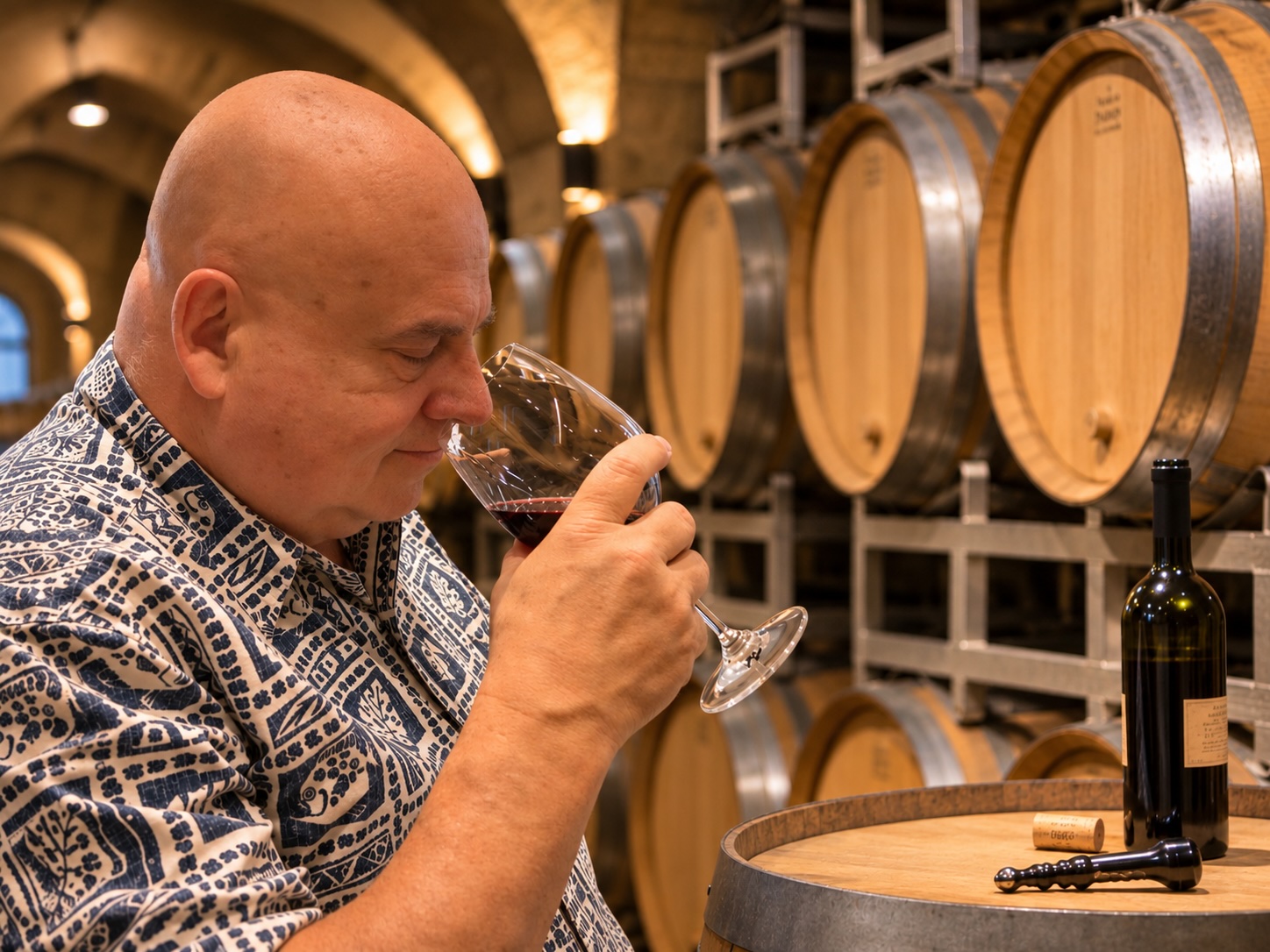
Your enological chemist hard at work.
Like a fine wine, a relationship can improve with age.
Note the operative word. “Can,” not “will.”
Some wines develop extraordinary character, depth and complexity. Others turn to vinegar. The same can be said for relationships.
If you’re newly in love, you can probably skip this one. Go back to making googly eyes at each other. I’m talking to those of you who’ve spent a good number of years together.
From lovers to logistics managers
One of the hazards of a long-term relationship is that, somewhere along the way, we (understandably enough) transition from lovers to logistics managers. There are extraordinary demands on our time, and most of them don’t feel particularly optional. The kids need to be fed. The rent needs to be paid. The dog needs to go to the vet.
Over time, couples become remarkably proficient at managing their shared enterprise:
- Who’s picking up the kids?
- Did you pay the property taxes?
- What are we doing for Thanksgiving?
- Whose turn is it to do the dishes?
Meanwhile, attending to the relationship itself starts to feel optional. Nobody sends you a late notice because you haven’t been intimate with your spouse.
Logistics are not life. Logistics are not joy. Logistics are not love. Logistics are simply a to-do list. And when we spend all our time doing, we have no time left for being.
Being playful. Being affectionate. Being curious. Being lovers.
There’s a certain irony in spending so much time managing the life we’ve built together that we forget to enjoy it.
And while we’re busy “managing stuff,” the chemistry of our relationship is changing. Whether we’re paying attention to it or not.
Getting older vs. getting better
Getting older requires remarkably little effort on our part. Getting better is another matter entirely.
Are you and your partner developing character, depth, complexity and a certain delicious uniqueness? Or are you putting in time like somebody serving a sentence?
The chemistry of your relationship doesn’t stop evolving just because you’ve exchanged rings, bought a house or celebrated your twentieth anniversary. Every interaction you have with your partner alters that chemistry, for better or for worse.
Now, I admit to you it may be more fun at times to pay more attention to enological chemistry than relational chemistry. But that bottle of wine can only be enjoyed once. Paying attention to relational chemistry pays off every day.
So, speaking of chemistry, here are a few litmus tests you can perform:
- When something interesting happens in your life, is your partner still the person you’re eager to tell? Are you equally eager to hear what’s happening in theirs?
- When you reach out to your partner for affection, do you anticipate a warm response, or have you learned not to expect one?
- Do you feel wanted by your partner, or have you simply become indispensable to the operation of the household?
If your answers to those questions left you feeling a little uncomfortable, it might be time to examine your relational chemistry. Perhaps there’s been an accumulation of negative interactions. Or perhaps you’ve gradually withdrawn from each other to avoid those interactions.
Too much acid (negative interactions) in the relationship eats away at intimacy. Too much base (emotional distance for the purpose of avoiding negative interactions) brings stagnation. The trick is to find the right pH balance.
That lovely bottle of Cabernet resting in my cellar can age beautifully without intervention. The same cannot be said for relationships.
Relationship chemistry has three ingredients
Relationship chemistry has three principal ingredients: you, your partner, and the relationship itself.
First, you. Are you still interested in discovering and developing who you are? Do you have aspirations, interests and curiosities that you bring to the relationship? What, exactly, are you bringing to the relationship to keep the chemistry fresh?
Next, your partner. Now, you were probably hoping I’d give your partner a list of ways to make themselves a better partner for you. Alas, the chemistry doesn’t work that way. You can’t do your partner’s growing for them, but you can help create an environment in which both of you can grow. And so you have to ask yourself: Am I interested in who my partner is becoming? Am I making room for them to grow, even in directions I hadn’t anticipated when we first got together?
And finally, the third ingredient: “Us.” What are we becoming together? Is there something more to our relationship that we haven’t yet discovered? What’s our shared dream?
One way to keep all three ingredients fresh is through conversation. Not conversations about what needs to get done, but conversations about who we are, who we’re becoming, and what we want out of our life together.
Having these conversations – even when things are good – can help keep them good and make them even better. Here are some conversation starters, usable with or without an opened bottle of wine within easy reach:
- How do you think our relationship has changed since we first met?
- What do you appreciate about our life together that you didn’t appreciate ten years ago?
- What’s becoming more important to you as you get older?
- What would you like us to experience together that we haven’t yet?
- What might we do differently to draw closer to each other?
Depending on your relationship, it might be helpful to volunteer your own answer before asking for your partner’s. Sharing something of yourself makes it a little safer for your partner to do the same. Even better, it gives your partner an opportunity to discover something about you, too.
For goodness’ sake, don’t let this conversation turn into a discussion about getting the kids to the orthodontist on time. It’s about you, your partner, and your relationship.
And please, dear reader, don’t put these questions on your to-do list. Our poor logistics managers have enough to do already.
Instead, find some time to simply be together. Pour yourselves a glass of something lovely. Be interested in yourself, be interested in your partner, and be interested in what the two of you might yet become.
There’s still plenty of chemistry left in that bottle.
What you make of it is up to both of you.